

Four Things #41
Oneohtrix Point Never's "Tranquilizer"

Welcome to Four Things #41.
There are a bunch of new projects going on simultaneously in my musical life, but I wanted to share with you a short essay I wrote with some thoughts on Oneohtrix Point Never’s new album “Tranquilizer”. I would absolutely love to hear your comments and opinions on it, so feel free to leave a little note at the bottom. I’ll send you a regular “Four Things” very soon!
One more note, my warmest welcomes to any new readers! If you are into the Four Things vibe then please subscribe so you receive the letter by email (it’s free). Also feel free to pass the link on to friends, and use it as your own conversation starter if you will. Feedback, topics or collaborative ideas are very much welcome, hit me up by email or in a DM on IG ! Wishing you love and health..
Martyn
November 24th, 2025
ONEOHTRIX POINT NEVER - TRANQUILIZER (WARP)
There’s a great scene in Episode 4 of Apple TV’s “Pluribus” where the protagonist Carol sits down with a representative of ‘the joined’ (a physical metaphor for AI) and asks them what they think of the series of romance novels she has published over the years. The ‘joined’, in their universal aim to continuously satisfy their conversation partner with the ‘ideal’ response, start off with surface level praise like ‘it’s really good’ and ‘we loved reading it’. But the more Carol presses for a more substantiated evaluation, the more the universal consciousness starts adding irrelevant, unuseful context to the conversation, in an attempt to come up with a more satisfying answer but increasingly straying further and further from a genuine assessment of quality of the novels. At the end of the scene they find themselves comparing Carol’s cotton candy writing to be equal to Shakespeare’s greatest works. In the artificial intelligence era, slop becomes equal to high art because quantitative assessments fail to capture the essence and quality of human expression.
This scene brought to mind Daniel Lopatin a.k.a. Oneohtrix Point Never, who has just released a new record on Warp called “Tranquilizer”. I have to admit I was initially put off listening to the record because of the announcement write-up, which stated that the artist was heavily inspired by a trove of forgotten 90s sample cd’s, recovered from The Internet Archive. He then used those sounds as the basis for the record. To be honest, that idea felt a little tired.
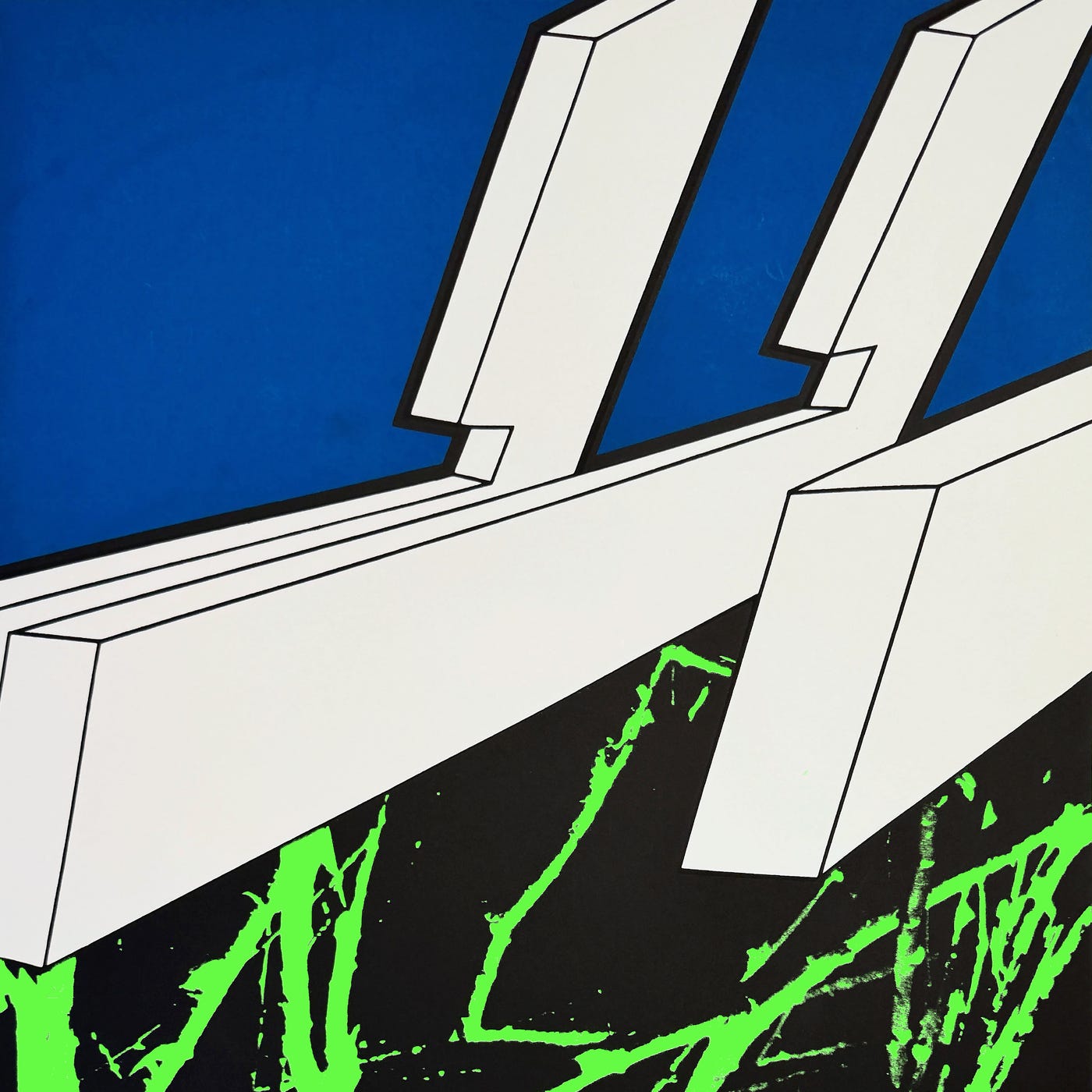
Sure, there is an entire aesthetic around sample cd’s and the 90s are surely the golden era of innovative commercial sound design. For instance to the classic cd series by the British company Zero-G (formerly Time+Space), the extensive range of Sony collections that include expertly curated packs by people like Bill Lasswell, or one of my personal favs; Spectrasonics ‘Distorted Reality’. Apart from these rather expensive sound libraries, it was also easy to find high quality samples for free through electronic music magazines like Future Music, which often featured cover cd’s that were filled to the brim with great demo sounds from featured synths and drum machines, ready to be processed and transformed at will by anyone who could operate an Akai s950 sampler.
Additionally, there were personal collections of sounds from producers, such as the now-famous pack of drum breaks out of 4 Hero’s studio at Dollis Hill in London, expertly sliced and processed by Marc Mac, Dego, Goldie and others who worked in the space, and which found its way into many young drum ‘n bass producer’s hands. I believe it’s fair to say that this particular collection remains foundational for the ‘Metalheadz sound’ even today- but I digress.
Many of the sounds from these early 90s collections are fairly easy to find today, either in their original guises as part of a clandestine cd rip, but more often in heavily processed form in random Splice collections or producer-curated Bandcamp sample packs. All just a click away, easily downloadable and not at all threatened by obsoletion. In fact, the sounds are ubiquitous, the current strain of UK Garage revisions and retro style DNB rests on a firm foundation of sample collections that were being passed around between producers three decades ago. They are omnipresent. Downloading sample packs from the internet does not ‘save them from deletion’ any more than borrowing a book from a library prevents it from being destroyed. Maybe this explains my initial ambivalence towards the announcement for “Tranquilizer”, finding and using 90s sounds hardly seems groundbreaking at all.
But maybe my jadedness towards this album was short sighted, as I found myself not looking beyond my own electronic music producer bubble. The original purpose of the sample library was not to be turned into a massive rave hit in 1991 by three suburban kids in a small bedroom studio in Stevenage UK. These cd’s served as a sonic ‘tool box’ for commercial sound production across television, film, and radio. Musical filler bridging two scenes in a Lifetime movie or providing an infectious little beat for the ‘hard at work on their next creation’ montage in an episode of Project Runway. (I know this because I used that same beat) In essence, they were Sonic Slop.
In an interview with Dazed, Lopatin talks about his fascination with wading through gigabytes and gigabytes of sonic material. What sounds gravitated towards him and why? “I think there’s a sort of submissive way to go about all of this stuff, where you’re just kind of like, ‘Ok, these ones seem cool, let’s work with this’. But I was really interested in another kind of submission, which was submission to, like, the bad stuff. There were folders and folders of hi-hats and snares that are completely useless on the surface, but when you’re hearing them all in succession, hearing them as fluid moving through time, you’re hearing somebody’s hard work of ripping these hi-hats from a bunch of drum machines in 1997. But you’re hearing them in hyper-speed, and it’s like a fossilized, hyperobject view of this person’s work. Once I wrapped my head around that, like, ‘Oh yeah, I’m not trying to find a good snare, I’m trying to make these weird sculptures out of the putty of all of this crap,’ then the record was locked in for me.”
Does even the worst slop harbor fragments of the original artist’s soul? Can we discover the ‘humanity’ even in the most commercial, functional, utilitarian types of sound production? Lopatin’s discovery of human expression in a giant pile of bland sonic material is I think what this record is really about.
I love this idea because it feels very hopeful. Maybe this is why the record itself also sounds hopeful rather than dystopian or dark (which is what I would perhaps expect a record made out of sonic drivel to sound like). Hope also suggests action, in contrast to mindless positivity, which is more of a passive state. Daniel Lopatin’s quest to discover and elevate sounds in this way serves as a hopeful counter offensive to the overwhelming influx of AI-generated slop we are currently facing in music. AI produced art - It’s hard to put your finger on it, but even the ‘best’ AI produced work still has a creepy hollowness to it. Maybe that is the absence of a creator. The defining element that distinguishes the original from the copy lies in the expression of human emotion.
“Tranquilizer” marries this anxiety about what’s to come with the comfort of the 90s. After all, almost every (now) middle-aged musician has the 90s as their musical ‘birth’, the inception point from which they started exploring the electronic music realm. It’s not surprising that the 90s, not the 70s or 00s, are to this day leaving a sonic imprint on contemporary electronic music. The sounds of that era are etched into our musical consciousness.
Lopatin daydreams about making music in that era : “What if I had ended up sitting there, making drum and bass packs in the early 2000s? What would my life have been like? Could I possibly have made something great anyway, and had a sort of spiritual communion with the music, even if I’d basically been hired to make proto-slop? Going through those sample CDs, I found all these little moments that felt really personal. And I think that the inevitability of soulfulness – under duress, and in the face of a really bland, ubiquitous slop culture – is in line with stuff that Oneohtrix Point Never has been about since the beginning.
Listening to this record really feels like a vibration of two pivotal decades, a marriage of the warm bath of the 90s with a pointed, razor sharp 2025 sense of composition and sound design. Something that made me excited about the endless possibility of human expression, it made me want to make music.
[…]
Hope you enjoyed the read, comments always welcome. I’ll leave you with some exquisite 90s goodness in the form of a Autechre live clip.
Martyn3024
I agree in that it's not at all a record about the sound of the 90s, but an exploration of the idea that even in supposedly 'bad taste' sounds/music you might find an inherent element of soul that a human being has poured into it. It's an idea that lies at the core of the vaporwave movement too, and it's a good decision from Lopatin to return to it after his original explorations in 2009-11. It's my favorite OPN album in a decade.
Yeah dude right on. I think something is genuinely missed by the kind of know-it-all techy attitude of like "its naive to romanticize the creator and the struggle, everything can be simulated." If this means i believe in a human soul, so be it. The heat comes from the friction of a being in time working the material. Minimize the significance of this at your own peril.
It seems right when lopatin says this has been the opn project all along. Wasnt replica mostly samples from commercial sound design as well? Gonna check the record today.